

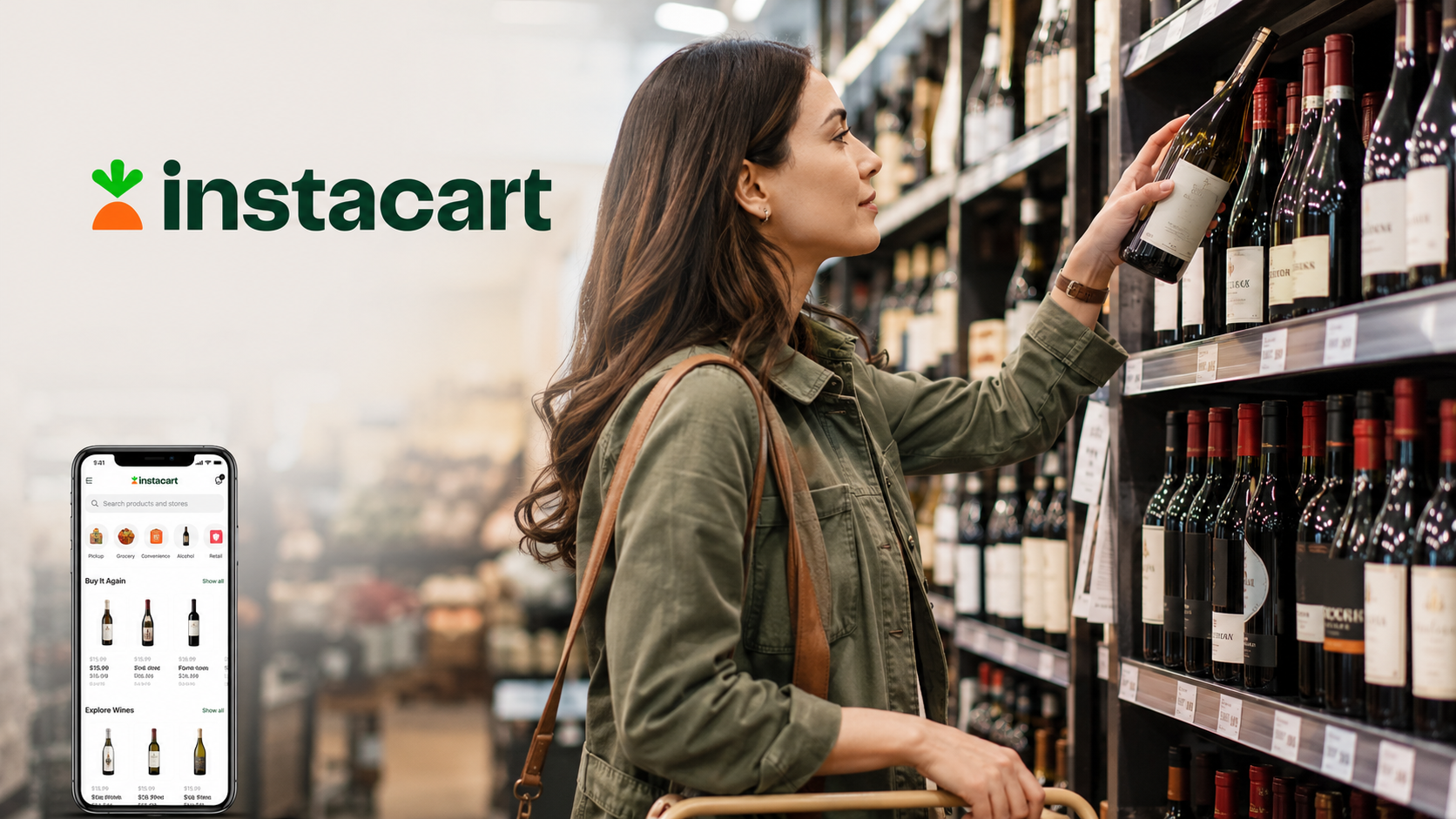
Instacart keeps coming up in winery marketing conversations. What I see less often is anyone fully leveraging it. Many brands are still on the sidelines, and those that are advertising frequently aren’t optimizing in ways that would meaningfully move the needle. That gap is worth addressing, because when these campaigns are built and managed well, the results are hard to ignore.
Over the past few years, I’ve built and managed Instacart advertising programs for winery clients that consistently deliver 8.0 to 11.4x return on ad spend, as measured within the platform itself. Just as meaningful as the efficiency is who those campaigns reach: between 30 and 48 percent of sales come from customers who are new to the brand on Instacart. For a winery investing in wholesale, that combination of strong returns and genuine customer acquisition is rare, and it’s worth understanding why it works and what it takes to get there.
More Than Grocery Delivery
Instacart is widely known as a delivery service, but it has quietly become one of the more sophisticated retail media networks in the country. When you advertise there, you aren’t buying impressions in a feed and hoping for intent. You’re reaching shoppers who are actively filling a cart with wine, at the very retailers that already carry your bottles. The purchase intent is already present. Your job is simply to be visible, and persuasive, at the point of decision.
That distinction is what makes the channel so well-suited to wine. It supports your wholesale business directly. Your retail partners hold the inventory, and your advertising drives the pull-through that strengthens those relationships and earns better shelf position over time. You’re building brand awareness and retail velocity at once, without standing up any new direct-to-consumer infrastructure to do it.
Start with Product Ads on a Few Key SKUs
The temptation with any new channel is to do everything at once. With Instacart, the more disciplined path performs far better.
I generally recommend starting with product ads built around a focused set of keywords, concentrated on the SKUs that matter most to your wholesale business. Rather than spreading budget thin across an entire portfolio, you put your investment behind the bottles with the distribution and the velocity to win: the wines already earning their place on shelves nationally. This gives the campaign a clear job to do and gives you clean data to learn from.
Keyword strategy is where much of the performance is made. Branded terms capture the shoppers already looking for you and tend to convert efficiently. Non-branded, category-level terms do something different and equally valuable: they put your wine in front of shoppers searching for a varietal, a style, or a price point without a specific brand in mind. That is where awareness and new-to-brand acquisition come from, and it is a meaningful driver of those new-customer figures.
Start Small, Then Concentrate Investment Where It Works
Just as important as where you start is how you scale. A high-performing Instacart program doesn’t begin with a large budget and an assumption that it will work. It begins small.
In practice, a campaign might open around a 3x return as it gathers data: which keywords convert, which SKUs respond, which retailers and audiences perform. Those early learnings are the entire point of starting modestly. As the picture sharpens, you concentrate spend behind what’s working and pull back from what isn’t, and that’s how returns climb from a respectable 3x toward the 8 to 11x range. The strong numbers aren’t the starting point; they’re the product of disciplined optimization over time.
This is also why creative and brand presentation matter more than many advertisers expect. Product imagery, varietal and appellation cues, and copy that reflects premium positioning all influence whether a shopper chooses your bottle over the one beside it. A generic approach yields generic results, even in a retail media environment.
Who This Is Right For
If your wines are carried by major grocery and specialty retailers across the U.S., you likely have more Instacart coverage than you realize, because the platform aggregates inventory across thousands of retail locations. A brand with solid regional or national distribution already has the foundation in place.
This is especially relevant for wineries growing their wholesale channel alongside DTC. Instacart doesn’t compete with your direct business; it complements it by building brand visibility and shelf velocity at retail while introducing new customers who may eventually find their way to your own channels.
Getting Started
Opening an Instacart Ads account is straightforward. Running campaigns that reach the kind of performance worth talking about takes platform fluency, a sensible starting structure, and the patience to let early learnings guide where the money goes.
If you’re curious whether your distribution makes you a strong candidate, and what a focused, SKU-led program might look like for your brand, I’m always glad to talk it through. This remains one of the most underleveraged opportunities I see in the wine industry, and the brands moving on it now are building a real head start.
Note About This Blog Post
This content was created with the help of Anthropic’s language model, Claude Opus, based on prompts and content curation by the team at DigitalMarketingWine.com. The AI created content was further reviewed and edited by a digital marketing expert. The information provided is based on industry best practices, and should be used for general guidance. To implement these strategies and tactics requires additional support and adaptation to business needs.